Stop Bolting AI Onto Broken Processes
Most businesses are making the same mistake with AI that factories made with electricity a century ago. They're bolting new technology onto old systems and wondering why results are underwhelming.
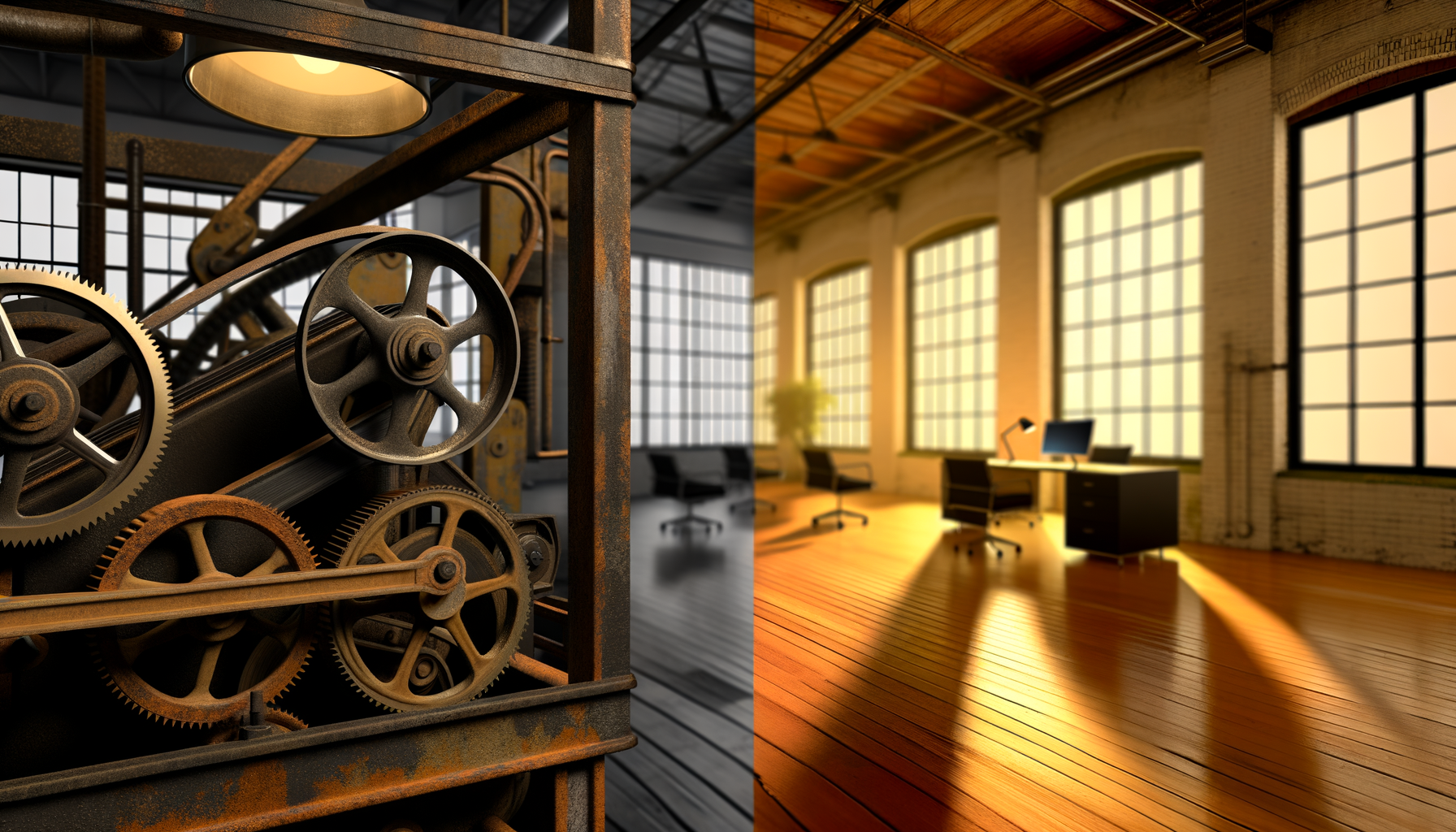
When electricity first arrived in factories in the late 1800s, something strange happened. Managers didn't redesign their buildings. They simply replaced the central steam engine with an electric motor and kept everything else the same—the same belts, the same pulleys, the same multi-story buildings designed to let power flow downward from a single source.
The result? Marginal improvement at best. Sometimes no improvement at all.
It took decades for manufacturers to realize that electricity's true potential required tearing down the old factories entirely. Steam-powered factories were built tall because power had to flow downward through gravity. Electric factories could be single-story, with machines placed wherever the work demanded. That fundamental redesign is what finally unlocked productivity gains that transformed manufacturing.
I see the exact same pattern happening with AI right now. And it's costing small businesses a fortune in wasted potential.
The AI Bolting Problem
Here's what I typically see when I talk to small business owners who've "tried AI":
A law firm added an AI chatbot to their website. It answers basic questions about office hours and practice areas. They wonder why it hasn't generated any new clients.
A medical practice started using AI to transcribe patient notes. The doctors still spend just as much time on documentation because the transcripts need heavy editing.
A construction company bought AI scheduling software. Projects still run late because the underlying process of how they gather requirements and communicate with subcontractors hasn't changed.
In every case, they bolted AI onto an existing process without asking whether that process was designed for AI in the first place. Spoiler: it wasn't.
Processes Built for Humans
Most business processes were designed around human limitations. We forget things, so we create checklists. We can only be in one place at a time, so we schedule appointments. We can only read so fast, so we create summaries and reports.
AI doesn't share these limitations. It doesn't forget. It can handle thousands of interactions simultaneously. It can process entire documents instantly.
When you bolt AI onto a process designed for human limitations, you're running electric motors through a steam-age power distribution system. The AI is constrained by all the workarounds you built to compensate for problems it doesn't have.
That's why the AI chatbot doesn't generate clients—it's answering the questions your FAQ page already answered, because the process wasn't redesigned to actually qualify leads and schedule consultations.
That's why transcription doesn't save time—the note-taking process was designed around a doctor dictating for a human transcriptionist who would ask clarifying questions and know the shorthand.
Redesigning for AI
The businesses getting real value from AI are the ones willing to tear down their multi-story factories and build something new. Here's what that actually looks like:
Instead of adding an AI chatbot that answers FAQs, redesign intake entirely. An AI-first intake process gathers information before the first human contact—understanding the client's situation, their timeline, their budget, what they've already tried. By the time a human gets involved, they have everything they need to have a productive conversation. No back-and-forth emails. No phone tag. The AI doesn't just answer questions—it runs the entire front-end of the client relationship.
Instead of transcribing notes that need editing, redesign documentation around AI capabilities. Train the AI on your practice's specific terminology and templates. Let it draft complete notes, not just transcribe. Have it cross-reference with patient history and flag potential issues. The human doctor reviews and approves rather than creating from scratch.
Instead of AI scheduling that still fails because requirements are unclear, redesign how projects get scoped. Use AI to run detailed intake with clients and subcontractors before any scheduling happens. Surface conflicts and ambiguities automatically. Generate realistic timelines based on historical data from similar projects. The scheduling software works because the inputs are finally reliable.
The Uncomfortable Truth
Here's what nobody wants to hear: implementing AI properly often means admitting your current processes are broken.
That intake process you've used for fifteen years? Built around the assumption that getting information from clients is hard and time-consuming, so you minimize it.
Your documentation workflow? Designed when creating written records meant someone had to manually type everything.
Your scheduling system? Developed when coordinating multiple parties required phone calls and faxes and hoping everyone got the message.
These weren't bad processes. They were good processes—for a world with different constraints. But pretending you can just add AI on top of them is like keeping your pulleys and belts while swapping in an electric motor.
Starting Fresh
The question to ask isn't "Where can I add AI to my existing process?" It's "If I were designing this process today, knowing AI exists, what would it look like?"
For most workflows, the answer looks radically different from what you're doing now. Often it means:
- Gathering more information earlier (because AI makes this cheap)
- Eliminating handoffs between people (because AI can maintain context across an entire workflow)
- Moving from reactive to proactive (because AI can monitor continuously, not just when someone remembers to check)
- Personalizing at scale (because AI doesn't get tired of customization)
This doesn't mean you need to rebuild everything at once. Pick one workflow that's frustrating you. Imagine you were designing it from scratch today. Build that new process with AI at the center, not bolted on the side.
The Real ROI
When you redesign processes for AI instead of bolting it on, the ROI looks completely different.
The law firm that redesigned intake saw consultation bookings increase 40%—not because they had a better chatbot, but because the entire path from "visitor" to "scheduled call" was reimagined.
The medical practice that redesigned documentation cut the time doctors spend on notes by 70%—not just transcription, but the entire workflow of creating, reviewing, and finalizing records.
The construction company that redesigned project intake reduced scheduling conflicts by half—not through better software, but through a process that actually gathered complete requirements before anyone tried to build a timeline.
None of these gains came from buying AI tools. They came from being willing to rebuild processes around what AI makes possible.
Moving Forward
I know the temptation. The AI vendors make it sound so easy: just plug in our tool and watch the magic happen. And honestly, that's sometimes true for narrow, well-defined tasks. If you need transcription and you're already set up for transcription, an AI transcription tool might just work.
But for the transformative gains—the ones that actually change your business trajectory—you need to think like those factory owners who finally built single-story plants. The technology isn't the hard part. The willingness to redesign is.
The good news is you don't need to do it all at once. Start with one broken process. Ask what it would look like if you designed it today. Build that. See what happens.
The factories that made the switch didn't just see incremental gains. They saw transformation. The same opportunity exists right now for businesses willing to stop bolting and start building.
Need help figuring out which processes to redesign? Book a free assessment and let's find the opportunities hiding in your current workflows.
Free: AI Readiness Checklist
Find out if your business is ready for AI automation. 10 questions, 2 minutes.